- +86 21 56076732
- rl@mdiecasting.com


Quick SummaryThis article explains three common dimensions used to describe roller chains: Pitch, Roller Diameter, and Inner Width. It also explains t...
A top roller conveyor chain is a specialized industrial conveyor chain designed with freely rotating rollers mounted above the chain. The chain transm...
IntroductionExtended pin conveyor chains are widely used in automated conveying systems where additional mounting points are required for fixtures, pa...
Roller chains are one of the most widely used mechanical components for power transmission and material handling systems. They are commonly found in i...
IntroductionIndustrial chains are widely used in lifting equipment, power transmission systems, and material handling applications. However, two types...
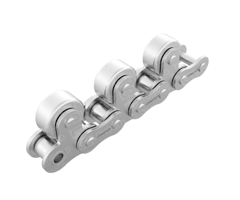
A top roller conveyor chain is a specialized industrial conveyor chain designed with freely rotating rollers mounted above the chain. The chain transmits power, while the top rollers support the workpieces during conveying. This structure allows workpieces to move smoothly and accumulate when required, making top roller conveyor chains suitable for automated assembly and material handling systems.
A top roller conveyor chain separates power transmission from workpiece support.
The chain runs continuously to provide the driving force for the conveyor system, while the top rollers rotate freely under the workpiece. When a workpiece needs to stop temporarily, the chain can continue running while the workpiece remains on the rollers. This allows multiple workpieces to accumulate without necessarily stopping the conveyor chain.
This accumulation function makes top roller conveyor chains particularly useful in production lines where different workstations may operate at different speeds or where temporary workpiece storage is required.
A typical top roller conveyor chain consists of a conveyor chain, extended pins and top rollers.
The chain body provides the main power transmission function. Extended pins are used to support the rollers, while the rollers directly contact and carry the workpieces.
The chain body can be based on a double pitch conveyor chain structure, providing a suitable combination of strength and conveying performance. The roller size, material and configuration can be selected according to the requirements of the conveying system.
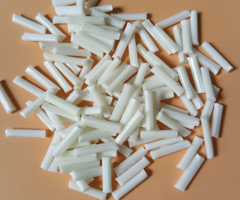 Roller material is an important consideration when selecting a top roller conveyor chain.
Glass-fiber-reinforced nylon (PA66+GF) is commonly used for engineering plastic rollers because of its self-lubricating, low-noise and corrosion-resistant properties. For applications involving heavier loads or higher temperatures, steel rollers can be considered.
Aluminum and nylon rollers may also be selected where lower weight or quieter operation is preferred.
The appropriate roller material should be determined according to the load, operating environment and requirements of the conveyor system.
The manufacturing process mainly includes chain production, roller production and final assembly.
The chain components are produced through processes such as plate stamping, pin machining, heat treatment and assembly. Engineering plastic rollers are generally manufactured by injection molding, while metal rollers can be produced through machining processes such as turning and milling.
During final assembly, the rollers are mounted onto the extended pins of the chain. Secure connection and smooth roller rotation are important quality requirements. The finished chain is inspected to ensure that the rollers rotate freely without sticking and that the chain meets the required dimensional and strength requirements.
Top roller conveyor chains are mainly used in automated conveying and assembly systems where smooth conveying and workpiece accumulation are required.
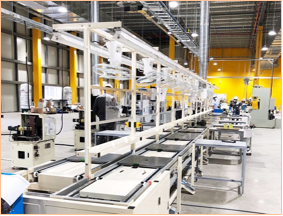
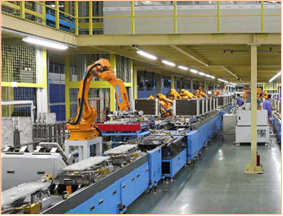
Typical applications include:
·Automotive component assembly – conveying components such as engine and seat parts.
·Home appliance manufacturing – conveying systems for products such as refrigerators and washing machines.
·Double-speed conveyor lines – automated assembly lines used in electronics and light manufacturing.
·Logistics and material handling – conveying and sorting systems where flexible material flow is required.
These applications benefit from the ability of the top rollers to support workpieces while allowing the chain to continue operating.
The appropriate top roller conveyor chain should be selected according to the requirements of the conveying system.
Important factors include:
·Chain type and pitch
·Workpiece weight and load requirements
·Roller material and dimensions
·Operating temperature and environment
·Required conveying conditions
·Whether workpiece accumulation is required
For customized conveying systems, the chain structure, extended pin dimensions, roller size and material can be specified according to the application requirements.
Top roller conveyor chains combine continuous chain-driven conveying with freely rotating rollers for workpiece support and accumulation. Their ability to separate power transmission from load carrying makes them suitable for automated assembly lines, manufacturing systems and other material handling applications.
Choosing the appropriate chain structure and roller configuration according to the operating conditions is essential for stable and reliable conveying performance.