- +86 21 56076732
- rl@mdiecasting.com


Quick SummaryThis article explains three common dimensions used to describe roller chains: Pitch, Roller Diameter, and Inner Width. It also explains t...
A top roller conveyor chain is a specialized industrial conveyor chain designed with freely rotating rollers mounted above the chain. The chain transm...
IntroductionExtended pin conveyor chains are widely used in automated conveying systems where additional mounting points are required for fixtures, pa...
Roller chains are one of the most widely used mechanical components for power transmission and material handling systems. They are commonly found in i...
IntroductionIndustrial chains are widely used in lifting equipment, power transmission systems, and material handling applications. However, two types...
Roller chains are one of the most widely used mechanical components for power transmission and material handling systems. They are commonly found in industrial machinery, conveyors, agricultural equipment, automotive systems, and many other applications.
However, with different types available on the market — including A Series, B Series, double pitch chains, and attachment chains — selecting the correct roller chain can sometimes be confusing.
What do the numbers in models such as 06A, 08A, and 12B mean?
What is the difference between A Series and B Series roller chains?
When should you choose S roller chains, R roller chains, or attachment chains?
This article explains the 8 common types of roller chains, including their identification methods, structural characteristics, and typical applications.
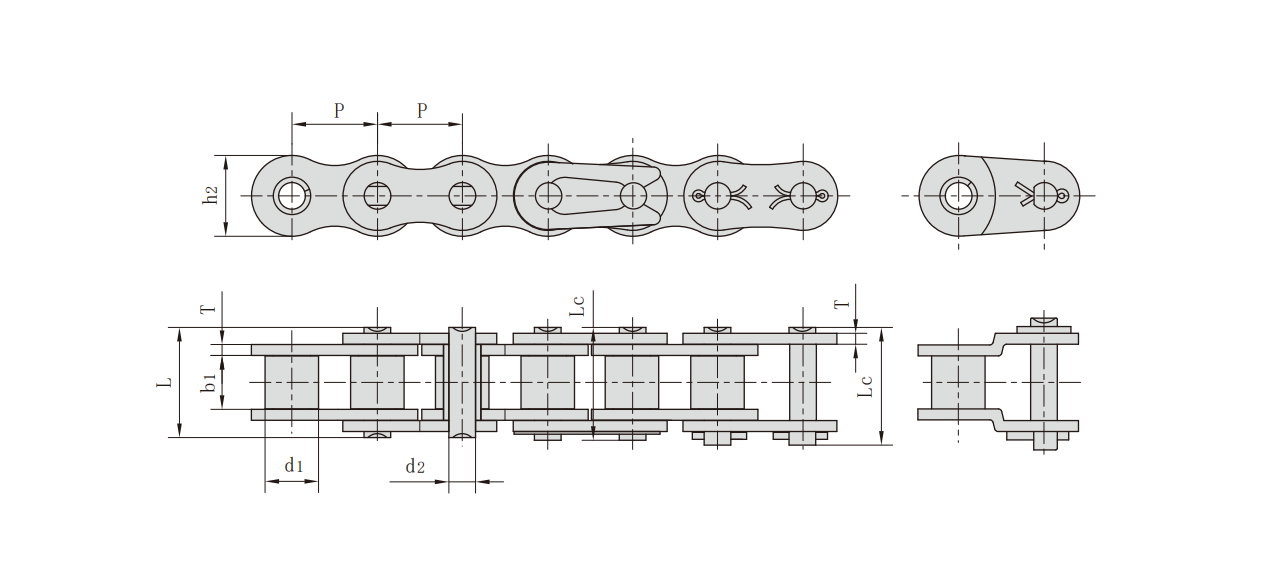
A Series roller chains are widely used industrial roller chains based on the ANSI (American National Standards Institute) dimensional system.
The number before the letter “A” indicates the chain size according to the ANSI numbering system.
For example:
| Model | Pitch |
|---|---|
| 06A | 9.525 mm (3/8") |
| 08A | 12.7 mm (1/2") |
| 10A | 15.875 mm (5/8") |
| 12A | 19.05 mm (3/4") |
| 16A | 25.4 mm (1") |
·The number represents the chain size and pitch.
·The letter “A” indicates the ANSI series.
·A larger chain number generally means a larger pitch and larger component dimensions.
·One of the most widely used roller chain types worldwide.
·Available in various sizes for different transmission requirements.
·Good interchangeability and easy maintenance.
·Suitable for a wide range of industrial applications.
·Machine tools
·Industrial machinery
·Agricultural equipment
·Conveyors
·Pumps and fans
·General power transmission systems
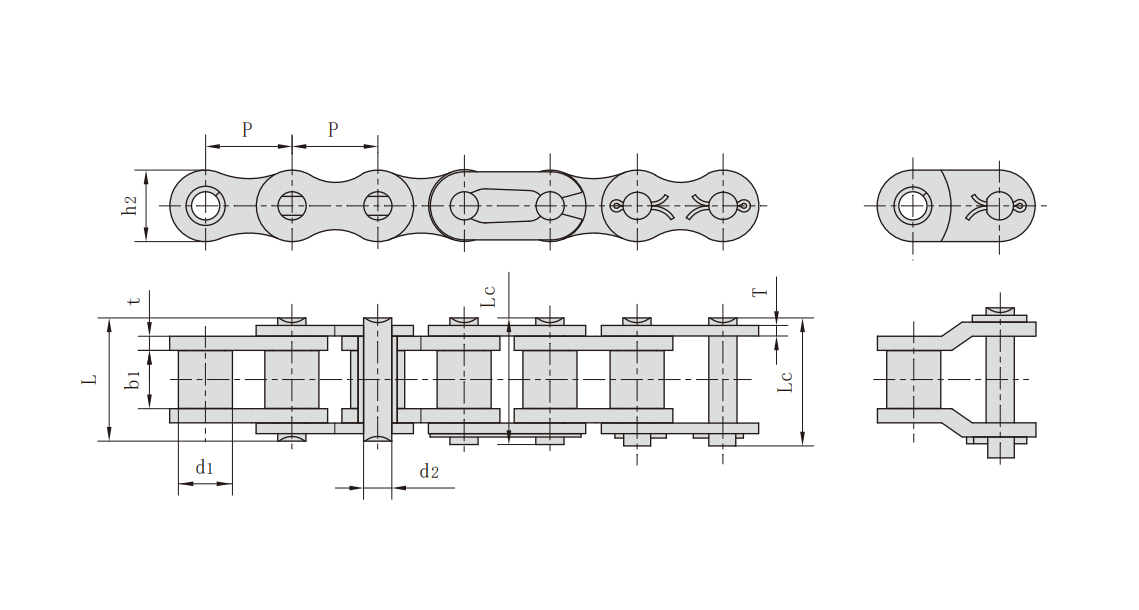
B Series roller chains are commonly manufactured according to British Standard (BS) and European dimensional systems.
The number before “B” also indicates the chain size and pitch.
For example:
08A and 08B both have a pitch of 12.7 mm
However, their roller diameter, inner width, and other dimensions are different
Therefore, A Series and B Series chains with the same number are not always interchangeable.
·Designed for BS/DIN standard equipment.
·Commonly used in European machinery.
·Compact dimensions for certain applications.
·Suitable for a wide range of industrial transmission systems.
·European industrial equipment
·Packaging machinery
·Textile machinery
·Food processing equipment
·General mechanical transmission systems
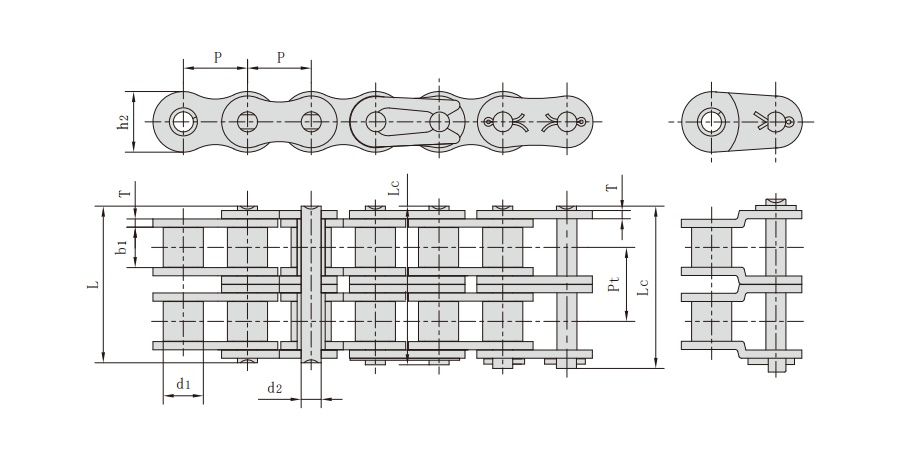
The suffix “-2” indicates a double strand (duplex) roller chain.
Example:
08 = chain size
A = ANSI series
-2 = double strand
·Provides higher load capacity than a single strand chain of the same size.
·Better load distribution.
·Suitable for applications requiring higher transmission power.
·Heavy-duty machinery
·Industrial drive systems
·Engineering equipment
·Pumps and compressors
·High-power transmission applications
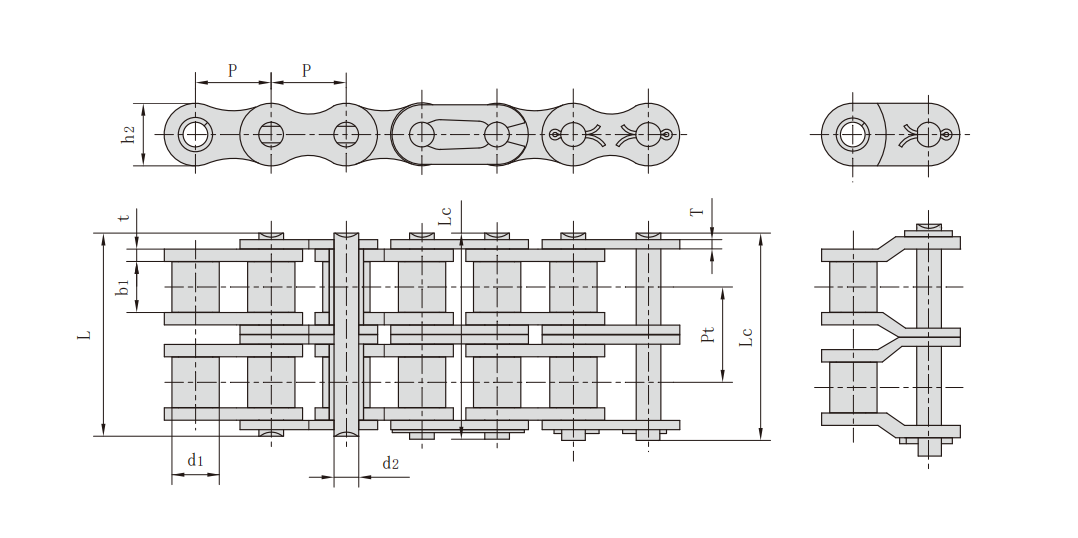
Double strand B Series chains combine the dimensional characteristics of B Series chains with increased load capacity from multiple strands.
·Designed for European standard equipment.
·Higher transmission capacity than single strand B Series chains.
·Not interchangeable with A Series double strand chains.
·European industrial machinery
·Packaging equipment
·Textile machinery
·Precision transmission systems
Double pitch conveyor chains have a pitch that is twice the pitch of equivalent standard roller chains.
The suffix:
S = Small Roller
Example:
C2040S
·C = conveyor chain series
·20 = double pitch series
·40 = basic chain size
·S = small roller
The final two digits correspond to the ANSI roller chain size.
·Lightweight design.
·Lower chain weight and cost.
·Suitable for long-distance conveying.
·Smooth operation under light loads.
·Light-duty conveyors
·Packaging lines
·Electronics assembly lines
·Small product handling systems
The suffix:
R = Regular Roller
R Type double pitch chains use standard-size rollers, providing better wear resistance compared with S Type chains.
·Higher load capacity than S Type chains.
·Better resistance to wear.
·Suitable for medium-duty conveying applications.
·Combines long pitch advantages with standard roller performance.
·Material handling conveyors
·Assembly lines
·Logistics systems
·Food processing conveyors
·Medium-load transport equipment
| Type | Roller Design | Typical Application |
|---|---|---|
| S Type | Small roller | Light-duty conveying |
| R Type | Standard roller | Medium-duty conveying |
Attachment roller chains are standard roller chains with additional plates or attachments used for conveying, positioning, or supporting products.
In many standard classifications:
·K1 / L1 generally indicate single-side attachments
·The front chain number and letter define the base roller chain specification
·Flexible design for customized conveying systems.
·Attachments can be used for pushing, supporting, or positioning products.
·Easy integration with different conveyor structures.
·Assembly lines
·Product transfer systems
·Light-duty conveyors
·Positioning equipment
Double-side attachment chains have attachments installed on both sides of the chain.
In many standard classifications:
K2 / L2 generally indicate double-side attachments
·Balanced loading on both sides.
·Suitable for applications requiring additional support or fixtures.
·Allows installation of wider plates, brackets, or tooling components.
The actual load capacity depends on the base chain size, attachment design, operating conditions, and application requirements.
·Heavy-duty conveyor systems
·Clamping conveyors
·Fixture transfer systems
·Continuous material handling equipment
When selecting a roller chain, consider:
·Required load capacity
·Operating speed
·Center distance
·Working environment
·Lubrication conditions
·Conveyor structure
·Required attachments
Roller chains are manufactured according to different standards, including ANSI, ISO, and BS/DIN systems. Chains with similar model numbers may not always have identical dimensions, so dimensional confirmation is recommended before replacement.
A Series → ANSI standard industrial applications
B Series → BS/DIN standard applications
Larger chain number → Larger pitch size
More strands → Higher transmission capacity
S Roller → Small roller conveyor applications
R Roller → Standard roller conveyor applications
K1/K2 → Attachment configurations
For custom roller chains and conveyor chains, MATECH can manufacture products according to customer drawings, samples, and specific application requirements.