- +86 21 56076732
- rl@mdiecasting.com


Quick SummaryThis article explains three common dimensions used to describe roller chains: Pitch, Roller Diameter, and Inner Width. It also explains t...
A top roller conveyor chain is a specialized industrial conveyor chain designed with freely rotating rollers mounted above the chain. The chain transm...
IntroductionExtended pin conveyor chains are widely used in automated conveying systems where additional mounting points are required for fixtures, pa...
Roller chains are one of the most widely used mechanical components for power transmission and material handling systems. They are commonly found in i...
IntroductionIndustrial chains are widely used in lifting equipment, power transmission systems, and material handling applications. However, two types...
Quick Summary
This article explains three common dimensions used to describe roller chains: Pitch, Roller Diameter, and Inner Width. It also explains the difference between a standard chain inquiry and a replacement or non-standard chain inquiry, including what information is usually helpful for each case. Basic drawing-reading tips and common inquiry issues are also covered to help purchasing teams and engineers communicate chain requirements more clearly.
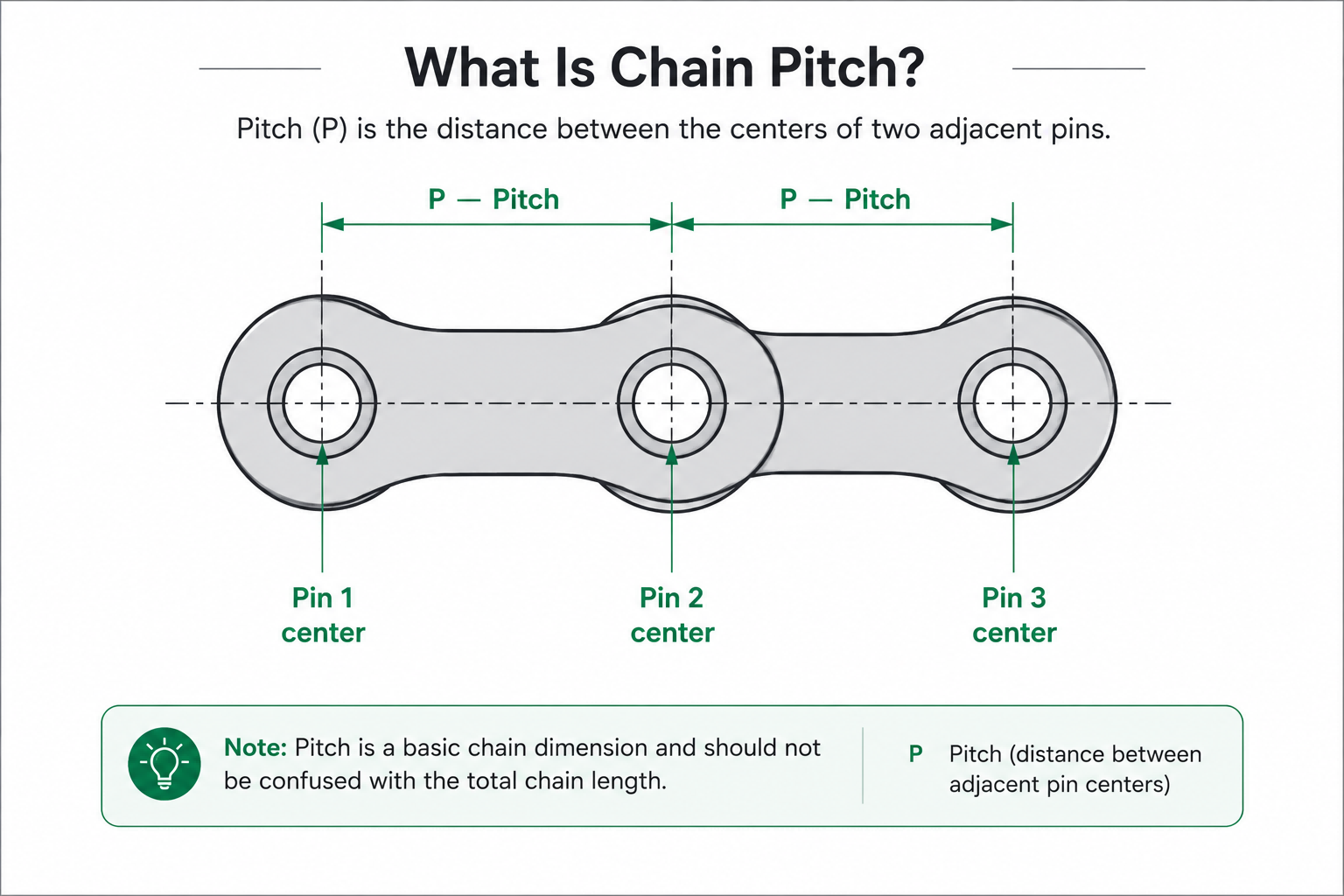
Pitch is the distance between the centers of two adjacent pins in a chain.
On a chain drawing, the pitch is usually shown between the centerlines of two neighboring pins. For example:
P = 25.40 mm
This means the distance between the centers of two adjacent pins is 25.40 mm.
Pitch is one of the basic dimensions used to describe a chain specification. It is also an important dimension in standard chain specifications.
One point worth noting is that pitch is not the same as the total chain length.
For example:
·Pitch: the distance between adjacent pin centers
·Chain Length: the overall length of the chain
These are two different pieces of information and should be specified separately in an inquiry.
In a typical roller chain, the rollers are installed around the bushings and form part of the chain's engagement with the sprocket.
Roller Diameter refers to the outside diameter of the roller.
In simple terms:
"Pitch describes the distance between adjacent pin centers, while Roller Diameter describes the outside diameter of the roller."
Roller diameter is not only a structural dimension of the chain. It is also related to how the chain engages with the sprocket.
Two chains may have the same pitch but different roller diameters. In that case, they are not necessarily interchangeable with the same sprocket. If the roller diameter does not match the corresponding sprocket tooth space, the chain may not engage properly.
This is one reason why, for replacement or non-standard chains, pitch alone may not be enough to confirm that the chain matches the existing application.
For standard chains, the relevant dimensions can usually be checked against the applicable standard or specification data.
Inner Width generally refers to the internal width between the two inner plates of the inner link.
Looking at the chain from the width direction, it can be understood simply as:
"The space between the two inner plates."
Depending on the manufacturer or specification, this dimension may also appear as:
·Inner Width
·Inner Link Width
·Width Between Inner Plates
The terminology may vary slightly, so the dimension drawing should be checked when necessary.
For standard chains, the inner width is normally included in the relevant specification. For replacement chains or non-standard designs, it may need to be confirmed from a drawing, sample, or measured dimensions.
The three dimensions describe different parts of the chain:
| Dimension | What it describes |
|---|---|
| Pitch | Distance between the centers of adjacent pins |
| Roller Diameter | Outside diameter of the roller |
| Inner Width | Internal width between the two inner plates |
A simple way to remember them is:
Pitch → distance along the chain
Roller Diameter → size of the roller
Inner Width → internal space across the chain
They are not different names for the same dimension. Each refers to a different part of the chain structure.
Not every chain inquiry requires a complete set of dimensions.
The information needed usually depends on whether you are purchasing a standard chain or replacing an existing or non-standard chain.
If the chain model is clearly identified and it is a common standard specification, the initial inquiry can often be quite simple.
Usually, it is enough to provide:
·Chain model
·Chain length
·Quantity
For example:
"Roller Chain – 08B-1 – 20 meters – 100 meters"
For a standard chain, the manufacturer can usually refer to the applicable specification to confirm the basic dimensions.
If there are additional requirements, such as material, surface treatment, special attachments, or packaging, these can also be included in the inquiry.
More technical information is usually helpful when:
· Replacing a chain currently installed on equipment
· The original chain model is unknown
· The chain is non-standard
· The chain needs to be reproduced from an existing part
· The drawing does not clearly correspond to a standard chain specification
· The chain has special attachments or structural features
In these cases, useful information may include:
·Pitch
·Roller Diameter
·Inner Width
·Other key dimensions
·Chain drawing
·Physical sample
·Chain length
·Quantity
· Special attachments or structural requirements
If a complete drawing is available, providing the drawing is usually the most straightforward way to communicate the requirements. If not, a physical sample or accurately measured dimensions can also be useful.
Chain length can be specified in different ways, for example:
·20 meters
·500 links
·500 pitches
These are different ways of describing chain length, so the value and unit should always be stated clearly in an inquiry.
This is especially important when meters and links or pitches are used interchangeably during communication.
For a replacement project, a photo of the existing chain is often a useful starting point. It can help identify the general chain structure, appearance, and special features.
However, if the photo does not include a clear size reference and there is no model number, drawing, or physical sample, a photo alone usually cannot accurately confirm dimensions such as Pitch, Roller Diameter, and Inner Width.
For example, a photo showing a chain coiled into a roll can provide useful information about its appearance, but it normally cannot show the actual dimensions accurately. The same applies to a wider photo of a chain installed on equipment.
If available, the following information can make identification more reliable:
Photo + Model Number
Photo + Key Dimensions
Drawing / Physical Sample
If a drawing is not available, clear photos together with a few measured dimensions can still provide a useful starting point for further confirmation.
A photo is helpful for identifying the chain's general structure, while a drawing, sample, or measured dimensions usually provide more reliable information for confirming its actual size.
Besides Pitch, Roller Diameter, and Inner Width, a few other details are worth checking when reviewing a chain drawing.
Check whether the dimensions are given in:
·mm
·inch
·or another unit
Both metric and imperial dimensions are commonly encountered in international chain inquiries, so the unit should be clear.
If tolerances are specified on the drawing, they should be considered together with the nominal dimensions.
For example:
> 25.40 mm ± 0.05 mm
provides different information from simply stating:
> 25.40 mm
If the chain includes special features, it is useful to mention them in the inquiry, such as:
·Extended pins
·Attachment plates
·Bent plates
·Guide structures
·Special connecting arrangements
These details may not be fully described by a standard chain model alone.
·Model
·Chain length and unit
·Quantity
·Any special requirements
·Pitch
·Roller Diameter
·Inner Width
·Other key dimensions
·Drawing or physical sample
·Chain length and unit
·Quantity
·Special attachments
The goal is not to provide as many dimensions as possible. The important thing is to provide the information needed to clearly identify the actual chain requirement.
For standard chain purchases, a clear model number will often provide most of the basic specification information needed to start an inquiry.
For replacement or non-standard chains, drawings, samples, and key dimensions can make specification confirmation much more reliable.
If you only have a photo of an existing chain, it is still useful to share it. Where possible, adding the model number, measured dimensions, drawing, or physical sample can make the next step much clearer.