- +86 21 56076732
- rl@mdiecasting.com


Quick SummaryThis article explains three common dimensions used to describe roller chains: Pitch, Roller Diameter, and Inner Width. It also explains t...
A top roller conveyor chain is a specialized industrial conveyor chain designed with freely rotating rollers mounted above the chain. The chain transm...
IntroductionExtended pin conveyor chains are widely used in automated conveying systems where additional mounting points are required for fixtures, pa...
Roller chains are one of the most widely used mechanical components for power transmission and material handling systems. They are commonly found in i...
IntroductionIndustrial chains are widely used in lifting equipment, power transmission systems, and material handling applications. However, two types...
Introduction
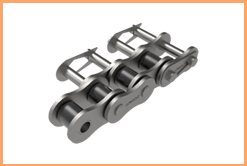
Extended pin conveyor chains are widely used in automated conveying systems where additional mounting points are required for fixtures, pallets, or customized attachments.
Unlike standard conveyor chains, extended pin conveyor chains use specially designed pins that extend beyond the chain plates. This structure allows components to be directly installed onto the chain, making them an efficient solution for applications that require precise positioning and stable transportation.
With proper material selection, heat treatment, and manufacturing control, extended pin conveyor chains can provide reliable performance in demanding environments such as automotive production lines, battery manufacturing equipment, and industrial automation systems.
An extended pin conveyor chain is a customized type of conveyor chain designed with longer pins than standard roller chains. The extended pins create additional connection points outside the chain plates, allowing users to install different types of attachments according to their conveyor design.
This design eliminates the need for complex additional mounting structures and provides a simple, reliable way to transport products, fixtures, and workpieces through automated production processes.
Compared with conventional conveyor chains, extended pin conveyor chains offer greater flexibility for customized conveyor systems, especially when accurate positioning and fixture mounting are required.
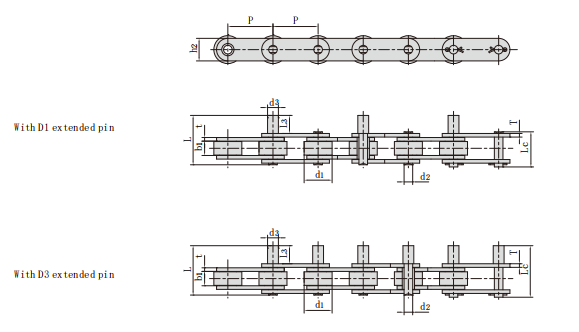
Different applications require different pin arrangements. According to the mounting requirements, extended pins can be manufactured in various configurations.
The D type configuration features extended pins on one side of the chain. It is commonly used where attachments or supporting components need to be mounted on a single side.
This configuration provides a simple and cost-effective solution for general conveying applications.
The D1 configuration places extended pins at every two pitches. Compared with continuous extended pin designs, it reduces the number of extended pins while still providing sufficient support for many conveying applications.
It is suitable for systems where attachment spacing is relatively large.
The D3 type provides extended pins on every pitch, creating continuous mounting points along the chain.
Because of its stable supporting capability and flexible attachment options, it is one of the most commonly used designs for automated production lines.
For applications requiring attachments on both sides of the chain, double-side extended pin designs can be provided.
This structure improves installation flexibility and is often selected for larger fixtures, wider conveyor systems, and customized automation equipment.
The service life and load capacity of an extended pin conveyor chain are highly dependent on material selection and heat treatment.
Different components require different mechanical properties. Chain plates need high strength and fatigue resistance, while pins require excellent wear resistance due to continuous contact and friction during operation.
Common materials include:
40Mn alloy steel
Suitable for general industrial applications with good strength and toughness.
40Cr alloy steel
Provides higher mechanical strength and improved fatigue resistance for heavier loads.
42CrMo alloy steel
Used for demanding applications requiring high strength, impact resistance, and long service life.
Extended pins are commonly manufactured from carburizing steels such as:
·20Cr
·20CrMnTi
After carburizing and heat treatment, the pins achieve a hardened surface layer while maintaining good toughness inside.
This combination helps improve:
·Wear resistance
·Fatigue performance
·Long-term operating reliability
Producing a reliable extended pin conveyor chain requires precise manufacturing processes and strict quality control throughout production.
Chain plates, pins, and other components are manufactured with controlled machining processes to ensure dimensional accuracy.
Important parameters such as pitch, hole position, and pin dimensions are carefully controlled because even small deviations can affect chain assembly and conveyor performance.
Heat treatment plays an important role in improving the mechanical properties of chain components.
Processes such as carburizing, quenching, and tempering are applied to achieve the required balance between surface hardness and internal toughness.
This helps the chain withstand repeated loading, friction, and impact during continuous operation.
During assembly, individual components are carefully matched to ensure smooth articulation between chain links.
The assembled chain is inspected for flexibility, dimensional accuracy, and overall consistency before delivery.
To ensure reliable performance in actual working conditions, extended pin conveyor chains undergo dimensional inspections and functional testing before shipment.
Key inspection items include pitch accuracy, chain width, pin extension length, and assembly consistency.
For applications with higher performance requirements, running tests, load tests, and fatigue tests can also be carried out to verify the chain’s load capacity, operating stability, and durability.
Extended pin conveyor chains are widely used in industries where products need to be transported with accurate positioning or mounted fixtures.
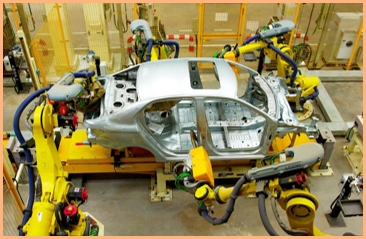
Automotive production lines often require conveyor systems capable of carrying components while maintaining accurate positioning.
Extended pin conveyor chains are commonly used for:
·Welding fixtures
·Assembly lines
·Body handling systems
Their stable operation and flexible attachment design make them suitable for automated vehicle manufacturing processes.
With the rapid development of electric vehicles, reliable conveyor solutions are increasingly important in battery production.
Extended pin conveyor chains can be used for:
·Battery module transportation
·Automated handling equipment
·Assembly systems
They provide stable conveying performance where accuracy and consistency are required.
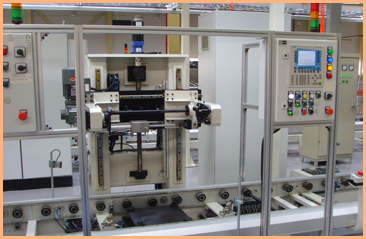
In customized automation equipment, conveyor chains often need to work together with fixtures and carriers.
The extended pin structure allows engineers to design compact and flexible conveying systems according to specific production requirements.
Selecting the right extended pin conveyor chain requires consideration of the operating environment and conveyor design.
Important factors include:
Load Requirements
The chain should be selected according to product weight, fixture weight, conveyor speed, and operating frequency.
Pin Design
The pin arrangement and extension length should match the attachment structure and positioning requirements.
Working Conditions
Factors such as temperature, dust, corrosion, and continuous operation should be considered when selecting materials and surface treatments.
Custom Requirements
For special applications, chain pitch, pin length, attachment position, and materials can be customized according to customer drawings and technical requirements.
As an experienced manufacturer of industrial chains, MATECH provides customized extended pin conveyor chain solutions based on customers’ equipment requirements.
We support customization of:
·Extended pin length
·Pin arrangement
·Chain structure
·Materials
·Surface treatments
By combining engineering support with manufacturing capabilities, MATECH helps customers develop reliable conveyor solutions for different industrial applications.
Extended pin conveyor chains provide an effective solution for automated conveying systems that require flexible attachment installation and precise product positioning.
Through proper material selection, advanced manufacturing processes, and strict quality control, a well-designed extended pin conveyor chain can deliver stable performance and long service life even under demanding industrial conditions.