- +86 21 56076732
- rl@mdiecasting.com


1. IntroductionDouble pitch precision roller chains are derived from standard short-pitch precision roller chains and are designed for both power tran...
Riveted Chain: Pins have dual staked rivets on both sides. Cottered Chains: Pins have dual staked rivets on one side and cotters on the other. Co...
Quick SummaryThis article explains three common dimensions used to describe roller chains: Pitch, Roller Diameter, and Inner Width. It also explains t...
A top roller conveyor chain is a specialized industrial conveyor chain designed with freely rotating rollers mounted above the chain. The chain transm...
IntroductionExtended pin conveyor chains are widely used in automated conveying systems where additional mounting points are required for fixtures, pa...
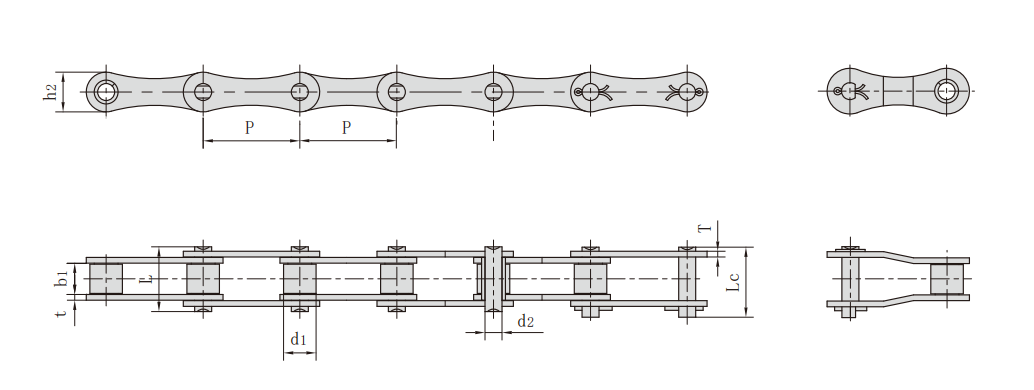
Double pitch precision roller chains are derived from standard short-pitch precision roller chains and are designed for both power transmission and conveying applications. They feature twice the pitch length of their corresponding standard roller chains while maintaining the same specified interchangeability dimensions.
With a longer pitch and fewer chain links over a given length, double pitch roller chains provide a lightweight and economical solution for applications involving relatively low operating speeds and longer center distances.
They are particularly suitable for chain conveyor systems, especially those with considerable distances between sprocket shafts, where a conventional short-pitch roller chain may not be the most economical choice.
The defining feature of a double pitch roller chain is its pitch, which is twice that of the corresponding standard precision roller chain. Despite the increased pitch, its tensile strength and hinge bearing area remain consistent with those of the corresponding short-pitch chain.
The extended pitch also provides additional space for larger rollers, allowing different roller configurations to be selected according to the conveying requirements.
Larger rollers can help reduce friction and sliding between the chain and supporting surfaces during conveying operations. Meanwhile, because fewer chain links are required over the same overall length, the number of articulating joints is reduced, resulting in less cumulative sliding movement within the chain's hinge joints.
These structural characteristics make double pitch roller chains particularly suitable for conveying applications where lightweight construction and efficient operation are important.
Double pitch precision roller chains offer several practical advantages:
Longer Pitch and Fewer Chain Links
With twice the pitch of the corresponding short-pitch roller chain, fewer chain links are required over the same overall length. This helps simplify the chain structure and contributes to a lighter construction.
Consistent Tensile Strength and Hinge Bearing Area
The tensile strength and hinge bearing area remain consistent with those of the corresponding short-pitch roller chain, providing the required mechanical characteristics for suitable transmission and conveying applications.
Reduced Joint Sliding Movement
Fewer articulating joints over a given chain length mean less cumulative sliding movement within the chain's hinge joints, helping reduce friction-related movement during operation.
Larger Roller Options
The extended pitch provides room for larger rollers, which can help reduce friction between the chain and supporting surfaces in conveying systems.
Economical for Suitable Applications
Their lightweight construction and reduced number of chain links make double pitch roller chains an economical option for low-speed transmission and long-distance conveying applications.
Although double pitch roller chains are derived from standard short-pitch precision roller chains, their different pitch lengths make them suitable for different operating conditions.
| Comparison | Standard Roller Chains | Double Pitch Roller Chains |
|---|---|---|
| Chain pitch | Standard pitch | Twice the corresponding standard pitch |
| Number of links | More links over a given length | Fewer links over the same length |
| Chain structure | Relatively compact pitch arrangement | Extended pitch arrangement |
| Typical applications | General power transmission | Low-speed transmission and conveying |
| Long center distances | Application-dependent | Particularly suitable for long-distance conveying |
| Roller configurations | Standard roller options | Standard or larger roller options |
The choice between the two types depends on the equipment design, operating speed, transmission requirements, and conveying conditions. Double pitch roller chains are generally preferred when longer center distances and relatively low operating speeds are involved.
Double pitch precision roller chains are widely used in industrial conveying systems and selected power transmission applications.
Their extended pitch and structural characteristics make them particularly suitable for equipment operating at relatively low speeds over longer distances.
Typical applications include:
Industrial chain conveyor systems
Material handling and conveying equipment
Packaging and assembly lines
Automated production lines
Low-speed power transmission systems
Conveyor equipment with long distances between sprocket shafts
For conveying applications, the selection of roller size and chain configuration should take into account the supporting surface, conveying load, operating speed, and equipment layout.
Double pitch precision roller chains are available in single-strand, double-strand, and multiple-strand configurations to meet different equipment and load requirements.
Single-strand double pitch roller chains are the most commonly used option for general conveying applications. Double-strand and multi-strand configurations can be selected when the equipment design or load requirements call for additional chain capacity.
The appropriate configuration should be determined according to factors such as conveying load, operating speed, sprocket arrangement, installation space, and operating conditions.
MATECH supplies industrial chains for power transmission and conveying applications, supporting custom requirements based on equipment design and operating conditions.
For double pitch roller chain projects, customers can share their drawings, chain specifications, or application details for further evaluation. Chain selection can then be assessed according to the required dimensions, roller configuration, operating conditions, and equipment requirements.
Double pitch precision roller chains provide a practical and economical solution for applications requiring a combination of power transmission and material conveying. Their extended pitch, reduced number of chain joints, and compatibility with larger rollers make them particularly suitable for low-speed operations and conveyor systems with long center distances.
Selecting the appropriate chain pitch, roller configuration, and strand arrangement according to actual operating conditions helps ensure reliable performance and efficient equipment operation.